- Decimal Odds
- Hong Kong Odds
- Indonesian Odds
- American Odds
- Malay Odds
 English
- English
 Vietnam

Vinícius Jr’s contract includes an unusual renewal bonus clause, a special case reserved for superstars


-
1
 AfsiezWon 16/20Follow80%Win Rate +45.4%ROI 20Tips 1.89Avg Odds
 -
2
 AbuleWon 14/17Follow75%Win Rate +21.3%ROI 20Tips 1.66Avg Odds
 -
3
 b3ndarWon 5/6Follow75%Win Rate +18.8%ROI 12Tips 1.82Avg Odds
 -
4
 udadheWon 8/10Follow73.7%Win Rate +53.9%ROI 19Tips 2.24Avg Odds
 -
4
 TopnotchWon 4/4Follow73.7%Win Rate +10.4%ROI 19Tips 1.50Avg Odds
 -
6
 KnightopeeFollow72.7%Win Rate +34.6%ROI 25Tips 1.97Avg Odds
Vinícius Jr’s contract includes an unusual renewal bonus clause, a special case reserved for superstars
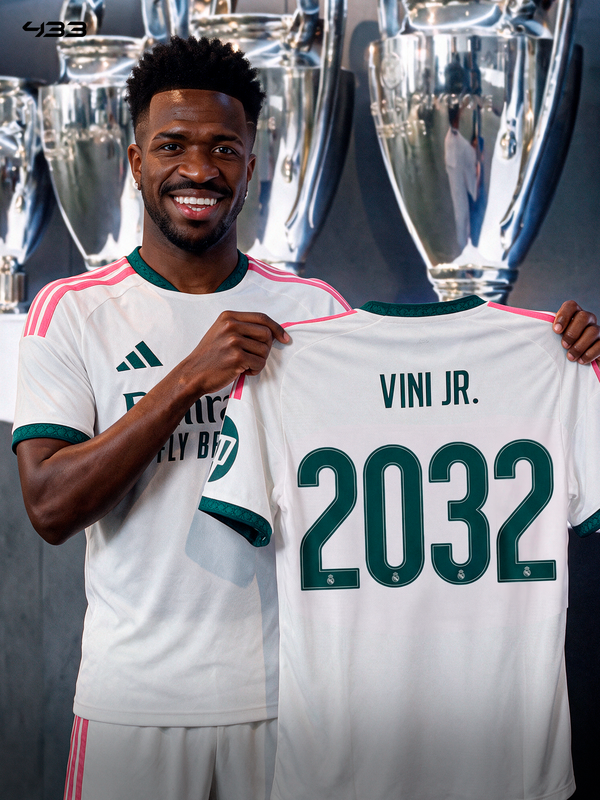
According to The Athletic, Vinícius Júnior agreed a contract extension with Real Madrid last week, with his new deal including an uncommon renewal bonus — a clause specifically designed for elite-level stars.
The report states that Real Madrid made a breakthrough in negotiations with Vinícius last week. Talks between the two sides originally began in January 2025, when the Brazilian forward rejected Madrid’s initial proposal and presented his own demands, including a renewal bonus.
Real Madrid had never previously offered this type of clause to a player, and it became the biggest point of disagreement during the 18-month negotiation process. However, last week the Spanish giants finally confirmed that Vinícius had signed a new contract extending his stay until 2032.
Although Premier League champions Arsenal had shown strong interest in signing him and were preparing an ambitious approach, Vinícius ultimately decided to remain at the Santiago Bernabéu.
But what exactly is a “renewal bonus”? Is it a new concept in contract negotiations?
The Athletic spoke with agents, scouts, sporting directors and other figures from clubs across England and Europe to explain how this type of payment works.
What happened?
On July 25, The Athletic exclusively reported that Arsenal were exploring an ambitious plan to sign Vinícius. His previous Real Madrid contract was set to expire in June next year.
Last Wednesday, August 5, representatives of the Brazilian met with Real Madrid general manager José Ángel Sánchez and chief scout Juni Calafat in the Spanish capital, with the long-running contract issue becoming the main topic of discussion.
The final salary package offered by Real Madrid was indeed higher than the €22 million (£18.8 million; around $25.4 million at current exchange rates) proposal Vinícius had rejected during the recent World Cup period.
However, both sides agreed to keep the exact figures confidential, aware that revealing those numbers could influence future contract negotiations with other Madrid stars.
The Athletic previously reported that the final agreement makes Vinícius Júnior one of the highest-paid players in Real Madrid’s history.
What is a renewal bonus?
The financial disagreement between the two sides was significant.
In January, The Athletic reported that Vinícius wanted a package worth around €30 million per year, including base salary, performance-related bonuses, and most importantly, a renewal bonus.
This meant that, in addition to his weekly wages, he wanted an extra payment for signing a new contract.
At the time, Real Madrid were reluctant to accept those demands. However, after last week’s meeting, the club changed its position and adjusted its offer.
Is a renewal bonus a new concept?
That depends on how it is described and interpreted.
A signing-on fee refers to an additional cash payment made by a club once a player agrees to join after a transfer.
Such payments usually emerge during transfer negotiations, especially when several clubs are competing for the same target. When a player has multiple offers, a signing fee can become an important incentive in convincing them to choose one club over another.
This payment is separate from the player’s normal salary and is particularly common when signing free agents, because the buying club does not have to pay a transfer fee to another team.
Historically, these payments were often made as a one-time upfront amount. For larger deals, however, signing fees can also be amortised and paid in instalments throughout the length of the player’s contract.
“Renewal bonuses, signing fees and loyalty bonuses are basically the same thing. They are all very common,” one agent said.
“In my opinion, this has become standard practice,” said a sporting director from a European club. “Players and agents will ask for many different things. You can call it a renewal bonus or a signing fee.”
Loyalty bonuses are usually paid in instalments throughout a player’s contract, sometimes monthly but more commonly annually, rewarding players for remaining at the club over multiple seasons.
However, this can sometimes create problems.
One Premier League club has reportedly been trying to sell a player for two years but has failed because the player knows he still has future bonuses to collect. Leaving would mean losing that additional income.
Most industry figures interviewed by The Athletic believe there is little difference between a signing fee and a renewal bonus.
However, one well-known sporting director disagreed. He believes the special attention given to Vinícius receiving a renewal bonus could make it a bigger issue in future negotiations.
“For me, this is something special and relatively new,” he said.
“A lot depends on the player himself. Bonuses of this size are only used for the very best players in a squad, and they are also influenced by the specific circumstances.”
“Normally, when you are dealing with players at this level, clubs try to complete renewal talks more than a year before the contract expires. They want everything settled early.”
“But if negotiations drag on until very late, a club could lose a transfer fee worth £200 million.”
“After a player renews, the club still has the opportunity to sell him for a huge transfer fee. But if negotiations fail and the player leaves for free, the club may have to spend a similar amount to find a replacement. The actual cost difference can be minimal.”
“So you have to consider compensating the player. It is very similar to a signing fee for a free agent, but I hope it does not become the norm. Otherwise, clubs will have to keep paying more and more money.”
“To avoid massive renewal bonuses, clubs need better long-term planning. That is not easy in football. They need to start renewal discussions earlier, perhaps three years before the contract expires.”
“Or they need to be more proactive when the player first signs, saying: ‘If you perform well, your next contract will include these conditions.’”
“So it is complicated, but also very interesting.”
Although Vinícius Júnior should be considered a special case because he is among the world’s elite players, every situation is relative.
When negotiating renewals, clubs may increasingly have to consider additional payments that are essentially similar to transfer fees, alongside higher wages.
“It is difficult to say whether this situation will happen at other clubs,” the sporting director added.
“It also depends heavily on the player’s age. For example, if Granit Xhaka played for Sunderland, he would undoubtedly be one of the best players in the squad. But at 33 years old, offering him a renewal bonus would be much more complicated.”
“It is the same principle as paying a signing fee when bringing in a new player. You have to consider the overall transfer market, whether other clubs are interested, and what offers those competitors are willing to make.”
“In my opinion, renewal bonuses like this are more likely to happen with younger players. They still have significant resale value, and replacing them would also be extremely difficult.”